
Motivation to Transfer: The Key to Unlocking Effective Learning and Real Workplace Change
Discover how motivation to transfer determines whether learning actually sticks. Learn what drives learners to apply knowledge, the role of proactive personalities, and how leaders can design training that truly transforms performance.
THE LEARNER
Motivation to Transfer: The Key to Unlocking Effective Learning and Real Workplace Change


Understanding the Concept of Motivation to Transfer
Every day, our perceptions shape how we engage with the world — and the same principle applies to learning. Motivation to transfer refers to a learner’s willingness and determination to apply newly acquired knowledge or skills to their job or real-life situations. It’s the bridge between learning and doing — the factor that determines whether training translates into performance improvement.
Even the most engaging, interactive, and well-designed training program can fail if learners don’t see how it benefits them directly. Without the motivation to transfer, learning remains theoretical — impressive on paper but irrelevant in practice.
The Link Between Learning Motivation and Transfer Motivation
Researchers like Grossman & Salas (2011) found a strong connection between motivation to learn and motivation to transfer. Learners who are eager to acquire knowledge are more likely to see its relevance and find ways to apply it in their work. This chain reaction — from learning enthusiasm to application — forms the backbone of effective training transfer.
When employees perceive training as meaningful and beneficial to their role, they engage more deeply, retain information longer, and take initiative to apply new skills. Conversely, if they see training as irrelevant or imposed, motivation to transfer plummets, and with it, organizational ROI.
The Science Behind Motivation to Transfer
Decades of research support this.
Studies by Bushe & Gilpin-Jackson (2007), Burke & Hutchins (2007), and Facteau et al. (1995) all emphasize that learners’ perceived utility of training directly affects whether they apply it. Vignoli and Depolo (2019) went further, surveying 617 trainees across different stages of a two-day training intervention. Their findings? Participants with higher motivation to transfer — both before and after training — showed significantly more transfer behavior later on.
Their study also highlighted the impact of having a proactive personality: individuals who actively seek opportunities to grow and achieve goals tend to transfer learning more effectively. However, most organizations can’t rely solely on proactive learners — which is why structured motivation strategies are essential.
The Psychology of Learner Motivation
Intrinsic vs. Extrinsic Motivation
Learners are motivated by different forces.
Intrinsic motivation comes from internal satisfaction — the joy of mastering something new or improving performance.
Extrinsic motivation comes from external rewards — promotions, recognition, or performance bonuses.
A balance of both creates the strongest foundation for motivation to transfer. While extrinsic motivators spark initial interest, intrinsic motivators sustain long-term behavior change.
The Role of Perception and Relevance
Learners constantly ask themselves: “Why should I care?” or “How will this help me?”
This is where perceived relevance becomes the linchpin of motivation to transfer. When learners can clearly see how training connects to their day-to-day challenges, they’re far more likely to apply what they learn.
Training that lacks context, on the other hand, feels detached and quickly fades from memory.
The WIIFM and WIIFMT Frameworks
A practical approach to boosting motivation is to make the WIIFM (What’s in it for me?) and WIIFMT (What’s in it for my team?) explicit.
Learning leaders should clearly communicate:
How the training enhances individual effectiveness and confidence.
How applying the learning benefits team outcomes and organizational success.
This dual framing aligns individual purpose with collective goals — and drives stronger transfer behavior.
Factors Influencing Motivation to Transfer
The Role of a Proactive Personality
Vignoli & Depolo’s (2019) work shows that a proactive mindset strongly predicts motivation to transfer. Proactive individuals take initiative, seek improvement opportunities, and persist despite setbacks — traits that make learning transfer more natural. However, even less proactive learners can develop transfer motivation when training is personalized and supported by leadership.
Managerial Support and Team Culture
Managers play a crucial role. When they reinforce learning through feedback, discussions, and performance alignment, learners perceive transfer as both expected and valued. A culture that celebrates continuous improvement transforms learning from an isolated event into an ongoing journey.
Explore articles and podcasts related to this area.
Research in Focus:
Summary
A 2022 study in Frontiers in Psychology assessed how learner motivation influences the transfer of knowledge in 132 service-learning courses involving 2,056 college students. Using structural equation modeling, the researchers measured intrinsic value and self-efficacy as motivational factors and analyzed their direct and indirect effects on real-world application. Results showed intrinsic value (β = 0.25) and self-efficacy (β = 0.18) both significantly predicted transfer outcomes, with the combined direct and motivation-mediated pathways explaining 50% of transfer variance.
Interesting Insight
Pedagogical support—such as instructor feedback and team collaboration—had the strongest impact on boosting intrinsic motivation (β = 0.45), underscoring that well-structured learning environments are key to fostering learner motivation and, by extension, enhancing learning transfer.
How Learning Designers Can Foster Motivation to Transfer
Even the most talented learners can lose interest if the training design doesn’t make learning stick. Learning designers hold the power to ignite and sustain motivation to transfer by strategically weaving relevance, engagement, and reinforcement into the learning journey.
Embedding Relevance and Real-World Contexts
To boost motivation to transfer, every learning experience should clearly answer one question for the learner: “Why does this matter to me?”
Here are proven strategies to achieve that:
Use authentic, role-based scenarios: Design exercises that mirror the learner’s work environment. When participants see themselves in the situation, they connect emotionally and intellectually with the material.
Leverage storytelling: Real-life success stories and case studies help learners visualize how applying new skills leads to tangible results.
Personalize learning paths: Adaptive learning technology can align content with each learner’s goals, making every module feel relevant and practical.
Highlight immediate benefits: Instead of vague long-term promises, emphasize what learners can gain today from applying what they’ve learned — better communication, reduced stress, improved efficiency.
When learners perceive value early, motivation naturally strengthens.
Reinforcing Learning After Training
Motivation to transfer doesn’t stop when the session ends — in fact, that’s when it truly begins. Without structured reinforcement, the enthusiasm from training dissipates quickly, leading to what’s known as the “learning decay curve.”
To counteract this, organizations can:
Implement follow-up sessions: Short refresher modules or “microlearning” reminders help maintain knowledge retention.
Encourage peer accountability: Pair learners to share progress and exchange feedback on applying new concepts.
Offer post-training coaching: Personalized coaching helps learners navigate real-world challenges and reinforces their commitment to apply new skills.
Celebrate small wins: Recognition and praise from peers or leaders can re-energize motivation and validate effort.
Reinforcement builds confidence — and confidence strengthens transfer motivation.
Measuring Motivation and Transfer Effectiveness
You can’t manage what you don’t measure. Evaluating motivation to transfer is vital for understanding not just what learners learned, but what they did with it.
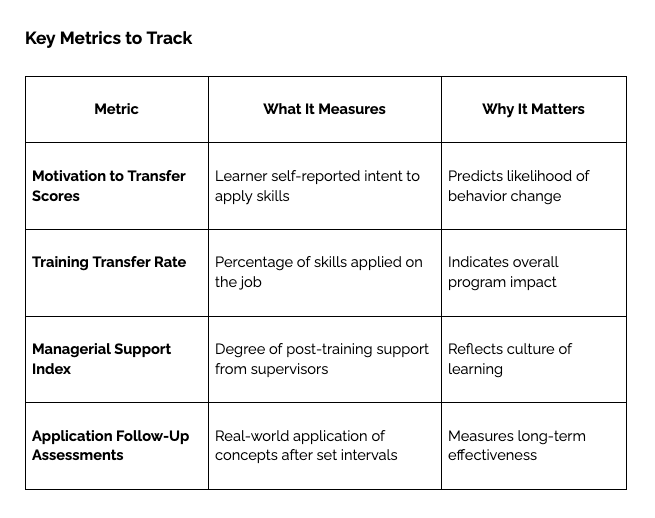
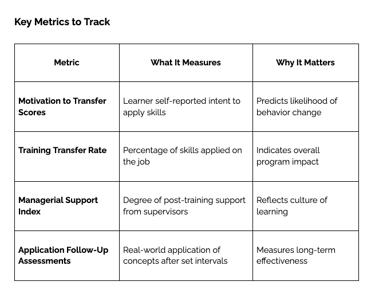
Surveys, behavioral observations, and post-training interviews can all be used to quantify transfer motivation and its outcomes.
Common Mistakes in Ignoring Motivation to Transfer
Despite overwhelming evidence, many learning initiatives fail to consider motivation to transfer in their design. Here are some pitfalls to avoid:
Assuming engagement equals transfer: Learners can enjoy training without applying it afterward. Engagement ≠ transfer.
Neglecting manager involvement: Without follow-up and reinforcement, knowledge remains theoretical.
Overloading with content: More information doesn’t mean better learning — it often leads to cognitive fatigue.
Ignoring individual goals: Training that doesn’t resonate with personal ambitions feels forced and unmemorable.
Lack of feedback loops: Without feedback, learners don’t know if they’re applying skills correctly, reducing confidence and motivation.
Avoiding these traps transforms your training from a one-time event into an ongoing process of growth.
Frequently Asked Questions (FAQs)
1. What does “motivation to transfer” mean in training?
It refers to a learner’s willingness and determination to apply newly learned skills or knowledge in their job or daily life. It’s the key factor linking training success to performance outcomes.
2. Why is motivation to transfer so important?
Because learning alone doesn’t guarantee change. Without motivation to apply learning, knowledge fades quickly and ROI from training diminishes.
3. How can organizations increase employees’ motivation to transfer?
By ensuring training relevance, fostering managerial support, reinforcing learning after training, and clearly communicating the “WIIFM” — What’s In It For Me.
4. What role do managers play in motivation to transfer?
Managers act as catalysts by encouraging, monitoring, and rewarding application of new skills. Their involvement signals that learning matters.
5. Can motivation to transfer be measured?
Yes. Through self-assessment surveys, behavioral observation, and performance metrics, organizations can measure both intention and actual transfer behavior.
6. What’s the difference between motivation to learn and motivation to transfer?
Motivation to learn is the desire to acquire knowledge. Motivation to transfer is the drive to apply it. The former sparks engagement; the latter sustains behavior change.
Conclusion: Building a Culture That Promotes Transfer
Ultimately, motivation to transfer determines whether learning translates into measurable improvement. When learners understand why training matters — and see the benefits for themselves and their teams — motivation naturally strengthens.
For learning leaders, the message is clear:
Don’t just design engaging content — design relevance.
Don’t just measure completion rates — measure application.
And don’t just inspire learning — inspire doing.
By embedding motivation to transfer into every stage of the learning process, organizations can transform training from a cost center into a true performance engine — one that fuels lasting growth, innovation, and success.
References
Burke, L. A., & Hutchins, H. M. (2007). Training transfer: An integrative literature review. Human Resource Development Review, 6(3), 263–296. https://doi.org/10.1177/1534484307303035
Bushe, G. R., & Gilpin-Jackson, Y. (2007). Learning to lead: Developing leadership identity in organizations. OD Practitioner, 39(3), 41–46.
Facteau, J. D., Dobbins, G. H., Russell, J. E. A., Ladd, R. T., & Kudisch, J. D. (1995). The influence of general perceptions of the training environment on pretraining motivation and perceived training transfer. Journal of Management, 21(1), 1–25. https://doi.org/10.1177/014920639502100101
Ford, J. K., Baldwin, T. T., & Prasad, J. (2018). Transfer of training: The known and the unknown. Annual Review of Organizational Psychology and Organizational Behavior, 5, 201–225. https://doi.org/10.1146/annurev-orgpsych-032117-104443
Grossman, R., & Salas, E. (2011). The transfer of training: What really matters. International Journal of Training and Development, 15(2), 103–120. https://doi.org/10.1111/j.1468-2419.2011.00373.x
Noe, R. A., Clarke, A. D. M., & Klein, H. J. (2014). Learning in the twenty-first-century workplace. Annual Review of Organizational Psychology and Organizational Behavior, 1(1), 245–275. https://doi.org/10.1146/annurev-orgpsych-031413-091321
Vignoli, M., & Depolo, M. (2019). The role of a proactive personality in training transfer: The mediating effect of motivation to transfer and self-efficacy. Journal of Workplace Learning, 31(2), 139–153. https://doi.org/10.1108/JWL-03-2018-0052